 Edit Line
Editing tool for the active line. There is also always one active point within the active line.
Active line point means also that the previous line section is active. Depending on the edit operation, target may be the active line point or the active line section.
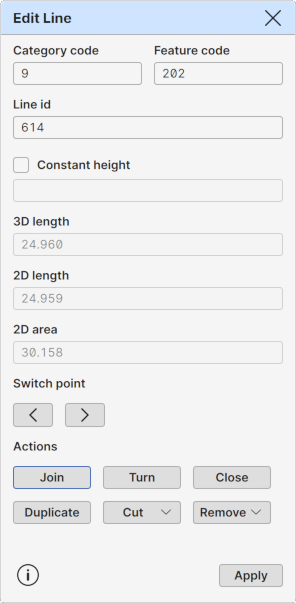
Category code, Feature code
Currently assigned Category and Feature codes of the selected line.
Buttons beside the fields activate code in the code list. If the code list is not currently visible, it is opened or activated automatically.
Line id
Id of the currently active line.
Active point height
Displays active line section end point height. Adjacent check button can be used to change it.
Constant height
Displays the constant line height, if all points of the active line have same Z-coordinate value. Can be used to force constant height to the line by pressing the adjacent check button.
Length
Current locked length of new line section. Adjacent locking icon forces its use.
Three button menu above can be used to select between 2D length or 3D length.
Slope
By default new point receives the height of the previous point. This can be changed by locking the slope setting. New point height is then calculated from the slope value and the length of the line section. Negative values are downwards and positive values upwards. For example, new 50 meter line section with the slope value of -2 percent goes down one meter.
Three button menu above can be used to select the slope unit: Ratio, Percent, Permille, Angle in degrees or Angle in gons.
Check button can be used to change existing line slope. When pressed it uses the given slope value and calculates new heights to all points forward from the active point.
Angle, Step
Angle setting allows locking of the line section direction. This can be either relative to the previous line section or absolute bearing angle. First line point direction is considered to be zero (usually north in surveying coordinate systems) making direction types equal at start. After that, negative relative angles turn leftwards and positive rightwards. Absolute direction values are normalized between zero and 360 degrees or 400 gons.
Three button menu above the angle setting can be used to select the angle type and unit: Relative degrees, Relative gons, Absolute degress or Absolute gons. The adjacent step setting uses always same unit.
Step setting rounds the angle direction to the nearest value divisible by it. For example, step of 90 degrees with relative angle allows only straight angle changes to the line direction. The checkbox beside the field turns it on or off.
See also: Add line mode
Switch point
Buttons change the active point within the line. The left arrow button moves towards the start of the line and the right arrow button towards the end of the line.
When pressed with the Shift-key, buttons activate the first or last point, respectively.
See also: Keyboard
Actions
Line edit operations.
Join
Starts the line joining mode. There must be active line before starting the mode.
Turn
Turns the line direction by changing the point order within the line. The active point within the line is changed to the opposite end of the active line section.
Close
Closes the line by adding new point at the end of the line with the start point coordinates. The line then forms closed polygon and is considered as an area by some operations.
Duplicate
Duplicates the active line. The new line is stored to the active element, which can be different from the original line element.
Cut
Splits the active line to two separate lines. By default, removes the active line section between new lines.
Popup option menu has following additional operations:
Shift: Keep common point Keeps the active section end point in both new lines.
Remove
Removes the active line.
Popup option menu has following additional operations:
Ctrl: Remove active point Removes the active line point. This option works also with the global Delete-key shortcut.
To Points
Converts the active line to single points.
Interpolate
Interpolates line point heights so that they form straight vertical profile. By default handles only zero height points. New heights for each zero height point or group of adjacent zero height points are calculated from point heights before and after them.
Shift: Interpolate all Interpolates new heights for all line points between the first and last points.
Add line
Starts Add line mode for adding a new line or new points to the active line.
Apply
Applies changes to the active line.